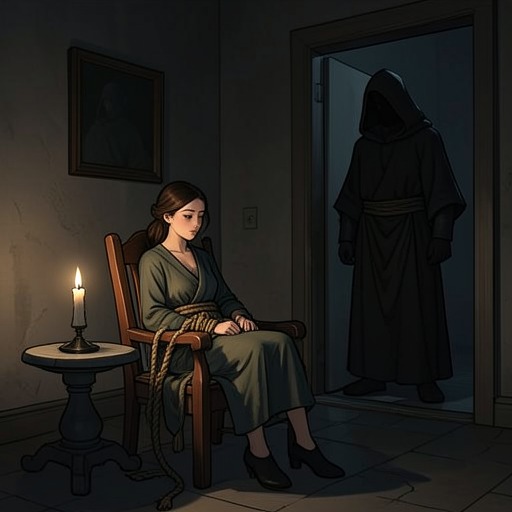
Celeste kidnapped by Samara
The Secret VampireCeleste's kidnapping by Samara is the imprisonment that converts a private misunderstanding into an open supernatural power struggle. After Samara has manipulated Callum into blaming Celeste for Carmilla's death, she has Celeste seized and hidden in a basement. The abduction is not merely an act of concealment: Samara explicitly treats Celeste as leverage against Callum, while Celeste's suffering awakens the emotional and supernatural forces that eventually expose Samara's crimes.
Causes and Background
Samara's scheme grows out of the conflict surrounding Carmilla's death. Susie, newly transformed into a vampire, has attacked Carmilla in the Forest, and Callum arrives to find his mother dead beside Celeste. A wooden stake falling from Celeste's bag helps Samara's deception succeed: Callum assumes that Celeste killed Carmilla, throws her against a tree, and later vows to make her pay. Samara celebrates because Callum's hatred of Celeste advances her larger plan to take over the vampire kingdom.
The false accusation leaves Celeste especially vulnerable. At the college, Susie threatens her not to tell Callum that she killed Carmilla, while Damien secretly records their confrontation. The footage could prove Celeste's innocence, but before Damien can show it to Callum, Celeste is attacked near an alleyway and dragged away. The sequence joins two forms of endangered testimony: Celeste possesses the truth but is removed from public view, while the recording exists as evidence but has not yet reached the person whose judgment matters most.
Abduction and Confinement
Celeste wakes after several hours with her hands and legs tied and her mouth taped. She does not know where she is, and the kidnapping initially appears as a disappearance to the people searching for her. Damien attempts to contact her, but Samara takes Celeste's phone before Gabriel can answer and throws it against the wall, destroying a possible line of rescue. In the basement, Celeste can only wonder who called and whether Callum, who believes he hates her, might still be trying to reach her.
The captor is revealed when Gabriel comes downstairs and finds Celeste restrained. Celeste asks why he kidnapped her, but Gabriel is not the principal architect of the abduction; Samara soon enters and identifies herself as the person behind the capture. She tells Celeste that the reason is Callum and explains that Celeste is a valuable bargaining piece. Samara calls her the golden ticket, intending to negotiate with Callum for greater power. The phrase defines the kidnapping's political logic: Celeste is treated less as a person than as an instrument capable of controlling the heir to the vampire royal family.
Samara maintains the captivity through deprivation and direct violence. Celeste becomes hungry and weak while confined, and Samara brings only stew and water. When Celeste rejects the food and spits it over Samara, Samara tortures her until she screams in pain. The basement therefore becomes both a literal prison and a pressure chamber for the struggle between them: Samara commands the space through locks, spells, and bodily force, while Celeste's refusal to accept the offered food preserves a small but consequential form of resistance.
Gabriel, Callum, and the Search
Gabriel's response creates the first internal fracture in Samara's household. He watches his mother imprison Celeste and thinks that she does not deserve such treatment. He secretly unlocks the basement, makes Celeste a peanut-butter-and-jelly sandwich, and gives her juice because she has not had a decent meal in days. Although he initially retreats upstairs, Gabriel later tries openly to persuade Samara to let Celeste go. Samara answers with a spell that weakens both Gabriel and Celeste, forces Celeste back downstairs, and leaves Gabriel struggling to breathe before threatening to kill him if he helps again.
Callum's connection with Celeste gives the captivity a supernatural dimension. While searching for her with Damien, he suddenly falls to the ground after feeling a stronger wave of her pain. He understands that someone is hurting her even before he knows where she is, and his response changes from revenge to rescue. When Vlad suggests that he should kill Celeste if Callum cannot avenge Carmilla, Callum violently rejects the idea and declares that Celeste did not murder his mother. The kidnapping thus breaks the certainty of the original accusation: Callum's bond with Celeste makes her suffering more immediate than the story Samara has constructed around Carmilla's death.
Callum's moral reversal is reinforced when Damien finally shows him the phone recording of Susie's confession. Callum realizes that Celeste was innocent and remembers the ways he hurt her, including attacking her in the hospital. He cannot yet face her, but the evidence redirects his anger toward the actual source of the deception. Samara's attempt to use Celeste as leverage consequently produces the opposite danger: it drives Callum to question both his father's demand for vengeance and Samara's version of events.
Samara's Escalation and the Wider Plot
While Celeste remains imprisoned, Samara extends her manipulation beyond the basement. She prepares a potion, transforms into Carmilla's form, and approaches Vlad while he is hunting in the woods. Vlad believes that his dead wife has returned. Samara traps him with a silver chain, which causes him agony, and uses the imitation of Carmilla to command him to avenge her death by killing Celeste. Vlad emerges from the encounter in a trance, promising to carry out the instruction.
This episode reveals why Celeste's captivity is central to the wider coup. Samara is not satisfied with controlling one victim; she seeks to control the vampire king, exploit his grief, and turn the royal family's own love and mourning against it. The basement prison and the enchanted forest operate as paired spaces of coercion. In one, Celeste is physically bound and tortured; in the other, Vlad is magically bound and emotionally deceived. Samara's power depends on making both kinds of captivity appear to be expressions of intimate loyalty.
Celeste's own consciousness resists that imposed role. In a dream, she sees Samara killing her mother and encounters Carmilla's spirit. Carmilla tells Celeste to be brave because Callum needs her, insists that Celeste is far from ordinary, and identifies her as Callum's soulmate. She also shows Celeste a memory from childhood and leaves her with a riddle whose meaning is not immediately clear. The dream does not erase the physical consequences of the kidnapping, but it changes Celeste's understanding of herself: the imprisoned human who believes she is powerless begins to recognize a special gift and a responsibility within the conflict.
Release, Exposure, and Consequences
Samara's control finally collapses when Celeste's hidden truth becomes part of a public confrontation. After Celeste is rescued, she uses her power to create a portal showing the past. The vision establishes that Samara killed Carmilla and Celeste's mother for power and that she also manipulated Damien's feelings by pretending to be Hannah in order to separate Celeste and Callum. Samara's confession transforms the earlier accusation into a documented crime rather than a dispute between competing claims.
The same power that emerges through Celeste's ordeal helps defeat her captor. When Samara tries to attack her and blames her for the exposure, Celeste uses the energy she has left to trap Samara in a magic hourglass. Vlad then places Samara in a dungeon cell and condemns her to remain there after learning that she kept Celeste imprisoned for days. The woman who converted a locked basement into an instrument of political leverage is herself reduced to a prisoner, while Gabriel's refusal to accept her actions confirms that her authority has failed even within her own family.
The kidnapping also alters Celeste's relationships. Susie initially responds to guilt and shame by embracing what she calls her darker vampire side, and she continues threatening Celeste before later recovering enough humanity to apologize and join the effort against Samara. Callum, meanwhile, moves from blaming Celeste and attacking her to recognizing her innocence and protecting her. After Celeste recovers, he brings her to the college sports field and proposes marriage, explaining that losing her had left him trapped, alone, and lifeless. The proposal does not cancel the violence of the kidnapping or Callum's earlier failure to believe her; it marks the final reversal by which Celeste's captivity becomes the crisis that forces truth, loyalty, and love to be tested rather than assumed.
Narrative Significance
The event concentrates the book's recurring Gothic oppositions: the castle and basement, the forest and the hospital, the visible wound and the hidden crime, the claimed beloved and the substituted image. Samara's abduction turns these spaces into instruments of secrecy and desire, but it also makes secrecy unsustainable. Physical restraint, magical compulsion, forged appearances, recorded testimony, dreams, and the portal of the past compete to determine who can define reality.
Celeste therefore remains more than a passive victim of the plot. She is deprived of movement and communication, yet her endurance, her refusal of Samara's food, her bond with Callum, and her eventual power to reveal the past allow her to reclaim narrative authority. The kidnapping begins as Samara's attempt to possess the decisive piece in a royal power game; it ends by giving Celeste the position from which that game can be exposed and overturned.